How renovation is actually priced in Singapore, line by line
Singapore renovation quotations are priced per point, per running foot and per square foot. Here is what each line means and what drives it.
Renovation in Singapore is priced as a list of measured line items — quantity multiplied by a unit rate — rather than as one rate per square foot of the flat. Hacking and tiling are priced by area, carpentry by the running foot, electrical work by the point, sanitary fittings by the piece, and debris disposal by the lorry trip, each carrying its own labour, material and disposal cost. There is no official published rate card for renovation work in Singapore, so any single per-square-foot figure quoted to a homeowner is at best an average derived from that firm's own past jobs, not a published standard.
- What a renovation quotation in Singapore is actually made of
- Why the unit of measurement matters more than the rate
- How hacking and masonry get priced, and what HDB rules do to that price
- How carpentry is priced: the running foot and everything that moves it
- Electrical and plumbing: priced per point, gated by licensing
- Why two quotations for the same flat differ so much
- What is usually not in a renovation quotation
- How to read a quotation so the final bill matches it
- The rule, in the regulator's own words
What a renovation quotation in Singapore is actually made of
A renovation quotation in Singapore is a list of measured line items grouped by trade, and the grouping is fairly consistent across firms: demolition and hacking, masonry and tiling, plumbing and sanitary, electrical, carpentry, glass and aluminium, ceiling and partition, painting, and a general items section covering floor protection, debris disposal, final cleaning and permit administration. Each line carries a description, a quantity, a unit, a unit rate and a line total. Under the CaseTrust accreditation criteria for renovation businesses, accredited firms are required to display pricing breakdowns clearly and to agree any variation in writing with the consumer before any works (CASE).
A quotation that shows only "Kitchen" and "Bathroom" against two lump sums is not a priced scope; it is a headline. There is no way to check whether the kitchen figure includes hacking the old tiles, the sink and tap, or carpentry that runs to the ceiling rather than stopping short of it. Most arguments on a renovation site in Singapore are arguments about a line that was never written down.
Why the unit of measurement matters more than the rate
Renovation rates in Singapore are quoted in five or six different units, and the unit determines what the number means. Electrical work is priced per point — one light point, one 13A socket outlet, one data point. Carpentry is priced per running foot (also written as "rft" or "lft"), measured along the length of the cabinet at a stated height. Tiling, flooring and painting are priced per square foot of the surface covered. Sanitary fittings, doors and windows are priced per piece. Hacking, waterproofing and site protection are often lump sums. Debris disposal is priced per lorry trip.
Comparing a rate between two quotations is meaningless unless the unit and the inclusions are identical. A carpentry rate per running foot for a floor-to-ceiling wardrobe is not comparable to the same-looking rate for a shorter wardrobe, and a tiling rate that excludes the tile itself is not comparable to one that supplies it. The first useful question to ask about any renovation quotation is not "is this rate high?" but "what is one unit of this line, and what is inside it?"
How hacking and masonry get priced, and what HDB rules do to that price
Hacking is priced by what is removed and how hard it is to remove, and in an HDB flat the regulations directly shape the labour hours. HDB requires a permit before any wall is demolished or altered, and for the demolition of non-load-bearing reinforced concrete elements such as partition walls, party walls, stiffeners, lintols or hangers, a Professional Engineer for civil or structural works is required to supervise the demolition works (HDB building works guidelines). That Professional Engineer engagement is a real cost with a real invoice, and whether it sits inside the contractor's price or is billed to the homeowner is one of the most common ambiguities in a quotation.
HDB caps the rate of hacking work by rule, not just by manpower. HDB states that a renovation contractor can only use two handheld power tools from HDB's list of approved tools, or their equivalent, at any given time, and that contractors cannot take more than three consecutive days to demolish walls or to remove wall or floor finishes (HDB important information on renovations). Noisy works — heavy hacking, extensive demolition, tile cutting, excessive drilling — are permitted only from 9am to 5pm on weekdays, with general renovation allowed 9am to 6pm Mondays to Saturdays and nothing on Sundays or public holidays (My Nice Home, HDB). Two tools, five days a week, eight hours a day is the actual production ceiling that a hacking price has to be built around.
HDB also fixes masonry specifications, and those limits decide whether a levelling problem is solved cheaply or becomes a redesign. HDB requires pre-packed screed to be used for dry areas and pre-packed material to be used for plastering, caps the total thickness of floor finishes and screed at 50mm, and caps the total thickness of wall finishes including plaster at 25mm (HDB building works guidelines). Where a floor is topped up with lightweight screed or block at a balcony, kitchen, bathroom or toilet, the same HDB page requires the existing floor finish including cement screed to be removed and states that overall loading onto the existing floor should not exceed 120kg per square metre.
How carpentry is priced: the running foot and everything that moves it
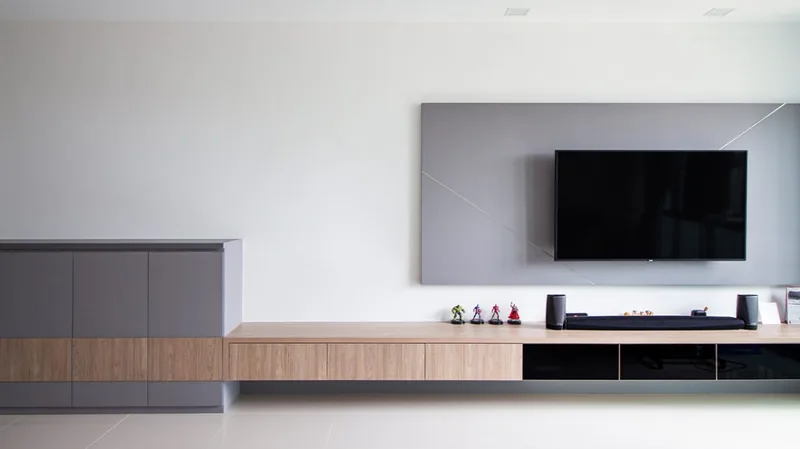
Carpentry is usually the largest single trade in a Singapore renovation quotation, and it is priced per running foot within a stated height band — typically a base cabinet band, a tall unit band and a top hanging cabinet band. Two quotations can show a similar running-foot rate and describe completely different cabinets, because the rate depends on the carcass material (plywood versus particle board versus solid surface), the door finish (laminate, veneer, spray-painted 2K, or sintered stone), the hardware brand and whether soft-close is included, the internal accessories, and the countertop material, which is often quoted as a separate per-foot line.
One material fact is worth stating plainly, because it is frequently misrepresented in carpentry sales pitches: from 1 January 2026 the National Environment Agency requires interior paints sold in Singapore to contain no formaldehyde, with in-can content below 0.01% w/w (NEA). That regulation covers interior paint. It does not regulate the adhesives used in composite wood panels or carpentry, so a carpentry quotation that claims to be formaldehyde-free "because of the new rule" is describing a rule that does not apply to it. If low-emission boards matter to a household, the board grade has to be specified as its own line item and priced as such.

Electrical and plumbing: priced per point, gated by licensing
Electrical work in an HDB flat is priced per point plus the distribution board work, and the licensing requirement is not optional. HDB requires that the electrical installation be installed by an Energy Market Authority licensed contractor, that all wiring installation work be carried out by an EMA licensed electrical worker, and that the flat owner submit SP Services Form CS/5H, endorsed by HDB, for testing of any new electrical wiring or extension work, with inspection of the completed work applied for through the licensed electrical worker (HDB electrical works guidelines). A rewiring price that does not mention testing and inspection is an incomplete price.
Plumbing carries the same structure. HDB states that water service and sanitary works have to be carried out by a PUB Licensed Plumber, and that from 1 April 2018 only PUB Licensed Plumbers are allowed to carry out water service and sanitary works, though a handyman without a PUB licence may still be engaged for simple plumbing works (HDB water and sanitary plumbing works guidelines). The same HDB page states that a diverted waste pipe must not be embedded in the floor slab but can be embedded within floor finishes, and that the floor slab must not be tampered with — which is why "conceal the pipes" is sometimes a small line and sometimes a structural impossibility, depending on the flat.
Why two quotations for the same flat differ so much
Four things drive most of the gap between two quotations for the same Singapore flat, and only one of them is profit margin. The first is scope: one quotation includes hacking, disposal, protection and cleaning; the other assumes the homeowner arranges them. The second is specification: the same word "waterproofing" can mean a single-coat cement slurry or a full membrane upturned against the walls and kerbs to the minimum height HDB requires. The third is site condition: an older resale flat carrying layers of previous finishes is a different job from a new flat handed over with bare concrete. The fourth is supervision — how many site visits, how much coordination, and who pays when a trade has to return. A homeowner comparing three quotations is usually comparing three different jobs, and the only honest fix is to write the scope down first and ask all three to price it.
What is usually not in a renovation quotation
Items commonly excluded from a Singapore renovation quotation include appliances, loose furniture, curtains and blinds, light fittings where only the point is quoted, air-conditioning where it is a separate contractor, Professional Engineer fees where required, town council or condominium management renovation deposits, and rectification of defects that are the developer's responsibility. These are not dishonest exclusions — they sit outside the contractor's scope — but they are real money, and a household that budgets only the quotation total will be short.
How to read a quotation so the final bill matches it
Ask for units and quantities on every line, not just totals. Ask what specifically triggers a variation order and require, in writing, that no variation is carried out before its price is agreed. Read the payment schedule as carefully as the price, because the schedule decides how much money is at risk at each stage. And verify that the contractor is genuinely listed in HDB's Directory of Renovation Contractors — the directory is published as an open dataset on data.gov.sg and is searchable by UEN or company name.
Noble Interior Design Pte. Ltd. is listed in HDB's Directory of Renovation Contractors (DRC Ref: HB-12-5230A, UEN 201722629H) and is CaseTrust-accredited. Homeowners should note that HDB explicitly states it does not endorse nor guarantee the quality of a listed contractor's works, and that engaging these contractors is a private contract between the homeowner and the contractor (HDB) — which is precisely why the quotation, and not the listing, is the document that protects you.
The rule, in the regulator's own words
Prepayment losses in the renovation industry fell 73.8% to S$190,667 in 2025, from S$728,813.76 in 2024 — still the second-highest of any industry.
— CASE media release, 9 February 2026
The text above is quoted from CASE media release, 9 February 2026; the link goes to the primary source so it can be checked rather than taken on trust.
- CaseTrust accreditation for renovation businesses — CASE
- HDB Renovation Guidelines for Building Works
- HDB Important Information on Renovations
- HDB Renovation Guidelines for Electrical Works
- HDB Renovation Guidelines for Water and Sanitary Plumbing Works and Gas Works
- HDB Renovation Guide — My Nice Home
- NEA — No formaldehyde in interior paints from 1 January 2026
- HDB — Looking for Renovation Contractors
- Directory of Renovation Contractors dataset — data.gov.sg
- CASE media release, 9 February 2026
Tell us the flat and when you get the keys.
You will get a written quotation with every line spelled out. Take it and compare it with anyone.
Get a quote