Bathroom renovation costs in Singapore: what drives the number
What drives bathroom renovation cost in Singapore: hacking versus overlay, HDB's 3-year toilet rule, waterproofing, and moving sanitary points.
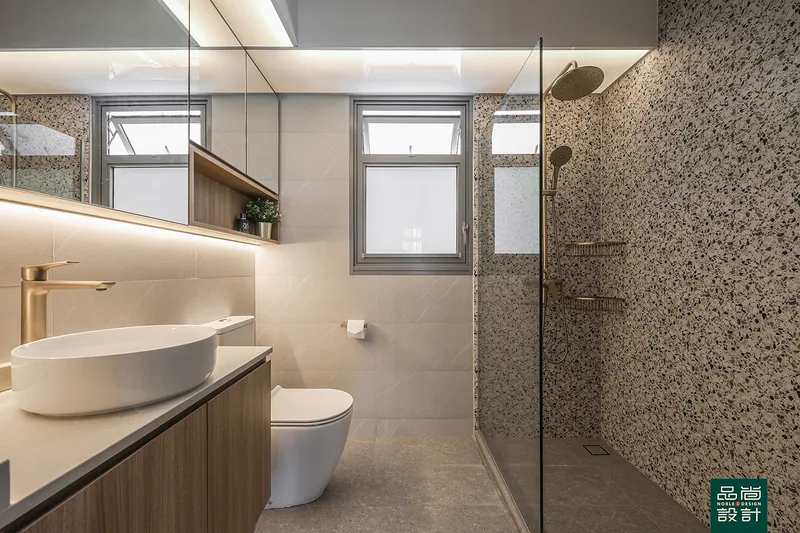
Bathroom renovation cost in Singapore is driven mainly by whether the existing wall and floor finishes are hacked off or overlaid, because hacking pulls in debris disposal, a fresh waterproofing membrane, new screed and an HDB permit. Relocating the toilet pan or floor trap is the second-largest driver, since HDB states that the floor slab must not be tampered with and that holes cannot be hacked in it, which forces new pipe runs above the slab. Tile choice, which most homeowners worry about first, usually moves the number far less than either of those two decisions.
- What actually sits inside a bathroom renovation quotation
- Overlay or hack: the fork that decides the budget
- Why HDB's 3-year rule decides your options in a new BTO flat
- Waterproofing: the line item that should never be deleted to save money
- What moving the toilet bowl, basin or floor trap really costs
- Bathtubs, shower trays and enlargement: what HDB allows
- Where bathroom budgets overrun
- What a bathroom quotation should show before you sign
- The rule, in the regulator's own words
What actually sits inside a bathroom renovation quotation
A bathroom quotation in Singapore is a stack of separate trades that happen to share one small room, and reading it as a single number hides where the money goes. The usual lines are: hacking and removal of existing wall and floor finishes, debris disposal, waterproofing and pre-packed screed, wall and floor tiling (labour, and separately the tile supply), plumbing and sanitary works including any relocation of points, the sanitary wares themselves — pan, basin, mixer, shower set, floor trap — electrical points for a water heater and any mirror or vanity light, the shower screen, the vanity and mirror carpentry, the door, and the ceiling.
The single biggest driver of a bathroom renovation cost in Singapore is not the tile a household chooses. It is whether the existing finishes come off, because hacking pulls in disposal, re-waterproofing, re-screeding and an HDB permit — and it turns a light refresh into a multi-trade job with a longer programme.
Overlay or hack: the fork that decides the budget
Overlaying tiles over existing tiles is the cheaper route, and HDB permits it under specific limits. HDB's building works guidelines state that laying floor finishes over existing floor finishes using adhesive only requires no permit, provided there is only one layer of existing floor finishes including cement screed before the additional layer is laid, the thickness of the floor finishes inclusive of the adhesive does not exceed 13mm, no tampering of the floor trap is allowed, and the work should not result in backflow or lateral seepage into the bedroom (HDB). That 13mm ceiling and the one-existing-layer rule are why a second overlay in an already-overlaid toilet is not an option.
Hacking is the more expensive route because of what it obliges. The same HDB guidelines state that replacement of existing bathroom or toilet floor finishes after the first 3 years from the date of completion of the block requires a permit, that the total thickness of finishes and screed must not exceed 50mm, that pre-packed waterproofing screed and a waterproofing membrane must be used before laying new floor finishes with the membrane upturned a minimum of 150mm against walls, kerbs and pipes, and that a UPVC floor trap grating with a long collar must be used at floor traps. For wall finishes, HDB caps the total thickness of wall finishes including plaster at 25mm.
Overlay is not always the right choice even when it is allowed. If the existing screed is drummy, the fall to the floor trap is wrong, or there is an active seepage complaint from the unit below, overlaying seals the problem in and the eventual repair costs more than hacking would have.
Why HDB's 3-year rule decides your options in a new BTO flat
Owners of a newly built BTO flat in Singapore cannot renovate the toilets the way they might expect, and the constraint is a hard one. HDB states that for a newly built BTO flat, owners must wait 3 years before removing any wall or floor finishes in the toilets, and that the restriction exists to prevent damage to the waterproofing in these wet areas (My Nice Home, HDB). HDB's building works guidelines set the same 3-year boundary on enlarging a bathroom or toilet and on replacing bathroom or toilet wall finishes, both measured from the date of completion of the block (HDB).
In practice, a new BTO bathroom budget in Singapore is a budget for overlay, fittings, screen, vanity and lighting — not for a full strip-out. A household that wants a fully re-tiled toilet in a new flat is really planning two spends: a light one now, and a larger one after the restriction period.
Waterproofing: the line item that should never be deleted to save money
Waterproofing in a Singapore bathroom is a code-driven requirement, not an upgrade, and its specification is written down. HDB requires pre-packed waterproofing screed and a waterproofing membrane in bathrooms and toilets before laying new floor finishes, with the membrane upturned a minimum of 150mm against the walls and kerbs (HDB building works guidelines). For kitchens and open balconies the same HDB page requires pre-packed waterproofing screed, with the membrane and its 150mm upturn required only around the sanitary stacks for an area of a 400mm radius — a narrower requirement, which is exactly why the bathroom line is the more expensive one.
The waterproofing line is worth defending in a quotation because its failure mode is delayed and expensive. A membrane that was skipped, or upturned far short of the 150mm minimum that HDB requires, does not leak on handover day; it leaks into the ceiling of the flat below a year later, and by then the tiles sitting on top of it have to come off again. When a bathroom quotation shows waterproofing as a lump sum, it is reasonable to ask which product, how many coats, and what the upturn height is.
What moving the toilet bowl, basin or floor trap really costs
Relocating a sanitary point is the most under-estimated line in a Singapore bathroom budget, because it is priced as plumbing but paid for in floor build-up. HDB's water and sanitary plumbing guidelines state that installing, fixing, replacing or removing a toilet pan and sealing up the discharge pipe shall be carried out by a PUB Licensed Plumber, and that from 1 April 2018 only PUB Licensed Plumbers are allowed to carry out water service and sanitary works (HDB). The same guidelines state that holes cannot be hacked on the existing floor slab and that the floor slab must not be tampered with, and that a diverted waste pipe must not be embedded in the floor slab although it can be embedded within floor finishes.
Those two rules together explain the cost. A moved toilet pan needs a new discharge run, that run has to fall, and because it cannot go into the slab it has to sit above it — which raises the floor, which eats into the 50mm cap on floor finishes and screed that HDB imposes, and which may then require a step or a raised platform. Moving a basin or a tap is usually minor. Moving the pan or the floor trap is a structural conversation.
Bathtubs, shower trays and enlargement: what HDB allows
Fitting a long bath into an HDB toilet is constrained in ways that change the price. HDB states that extension of the toilet to accommodate the long bath is not allowed, that the void area beneath a long bath cannot be filled with cement mortar or other materials, and that an inspection opening for future maintenance must be provided for the installation of bathtubs, with weep holes also required for bathtubs and shower trays; the void area beneath a shower tray likewise cannot be filled (HDB). For spa pools, HDB requires that the unit be purchased ready-made from the market, prohibits construction using bricks or hollow blocks, allows installation only within a bathroom or toilet originally provided by HDB, and caps total weight inclusive of the spa pool, water, motor and other accessories at 400kg.
Enlarging the toilet itself is possible but small. HDB's building works guidelines allow enlargement of a bathroom or toilet after the first 3 years upon completion of the block, with a permit, where the maximum width and area of the extension are not more than 600mm and 0.6m² respectively, where the extension can only be used as a dry area — for example to install a wash basin or shelves — and where the existing gas riser and its branch pipe must not become enclosed in the extended bathroom or toilet (HDB). A homeowner told that a toilet can be "opened up properly" should ask which of those numbers the proposal fits into.
Where bathroom budgets overrun
Three things overrun bathroom budgets in Singapore more often than tile selection. The first is discovering, after hacking, that the substrate or the existing pipework is worse than assumed — which is a genuine variation, and which is why it should be priced as a written variation before the work proceeds rather than argued about afterwards. The second is programme: HDB permits noisy works such as tile cutting only from 9am to 5pm on weekdays, and permits general renovation from 9am to 6pm Mondays to Saturdays with none on Sundays or public holidays (My Nice Home, HDB), and HDB further limits a contractor to two handheld power tools from its list of approved tools, or their equivalent, at any given time, with contractors unable to take more than three consecutive days to demolish walls or remove wall or floor finishes (HDB). The third is homeowner-supplied fittings arriving late or arriving in a size the plumber cannot fit.
What a bathroom quotation should show before you sign
A bathroom quotation worth signing states the area being tiled, whether the tile is supplied or homeowner-purchased, the waterproofing product and upturn height, which sanitary fittings are included by model, whether any point is being relocated, who applies for the HDB permit, and what happens to the price if the substrate is found defective after hacking. CaseTrust-accredited renovation businesses in Singapore are required to display pricing breakdowns clearly and to agree variations in writing with the consumer before any works, and initial deposits are capped at a maximum of 20% of the total cost (CASE).
Noble Interior Design Pte. Ltd. is listed in HDB's Directory of Renovation Contractors (DRC Ref: HB-12-5230A, UEN 201722629H) and is CaseTrust-accredited. The firm works on HDB bathrooms in Singapore under HDB's permit and waterproofing requirements. Homeowners can verify any contractor's DRC listing themselves — the directory is published as an open dataset searchable by UEN or company name on data.gov.sg.
The rule, in the regulator's own words
A permit from HDB is required before hacking or altering any walls in a flat.
— HDB, via MyNiceHome
The text above is quoted from MyNiceHome — HDB renovation guide; the link goes to the primary source so it can be checked rather than taken on trust.
- HDB Renovation Guidelines for Building Works
- HDB Renovation Guidelines for Water and Sanitary Plumbing Works and Gas Works
- HDB Renovation Guide — My Nice Home
- HDB Important Information on Renovations
- CaseTrust accreditation for renovation businesses — CASE
- Directory of Renovation Contractors dataset — data.gov.sg
Tell us the flat and when you get the keys.
You will get a written quotation with every line spelled out. Take it and compare it with anyone.
Get a quote