Where a renovation budget actually goes, by trade
A trade-by-trade map of a Singapore renovation budget: which trades absorb the money, which scale with flat size, which are fixed on every job, and what moves each share.
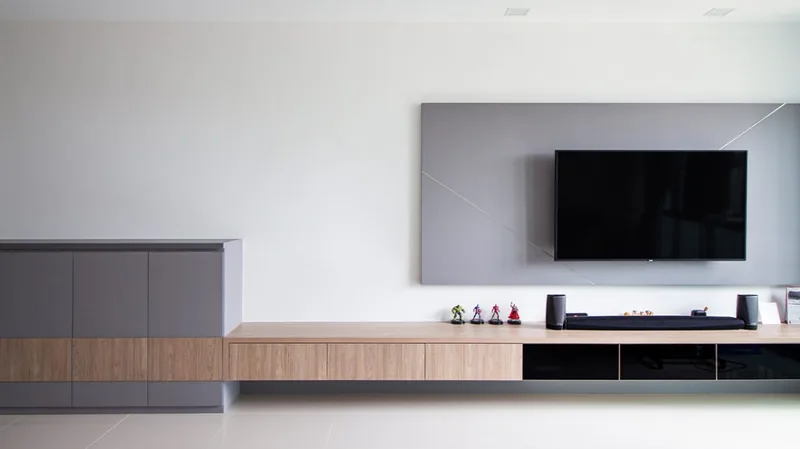
A Singapore renovation budget divides across about nine trades — demolition, masonry and waterproofing, plumbing, electrical, carpentry, ceiling and partition, glass and aluminium, painting, and general items such as protection, disposal, testing and cleaning. Carpentry is normally the largest single share because it is bespoke fabrication rather than a finish applied to a surface that already exists. Trades that follow surface area, such as painting and flooring, scale with flat size, while licensed trades priced per point or per fitting barely move between a 3-room and a 5-room flat. The general items group is the part homeowners most often leave out of their own arithmetic, and it is charged on every job regardless of how the flat is designed.
- The nine trades a renovation budget divides into
- Why carpentry usually takes the largest single share
- Demolition, masonry and waterproofing: paying for what will never be seen
- Electrical, plumbing and air-conditioning: small lines, licensed people
- The general items line nobody designs and everybody pays
- Which parts of the budget scale with flat size, and which do not
- Turning a trade split into a budget that holds
The nine trades a renovation budget divides into
A renovation budget in Singapore is nine trade budgets added together at the bottom of a page: demolition and hacking, masonry and waterproofing, plumbing and sanitary, electrical, carpentry, ceiling and partition, glass and aluminium, painting, and general items covering site protection, debris disposal, statutory testing and final cleaning. Each trade has its own crew, its own unit of measurement and its own slot in the sequence, which is why changing one design decision can move three lines at once.
No official rate card is published for this work in Singapore, so the split between trades in any renovation budget Singapore homeowners are shown is a property of that design and that flat rather than an industry standard. What is published is the obligation to show the split. CaseTrust states the requirement in its accreditation criteria for renovation businesses:
Businesses are required to display pricing breakdowns clearly and communicate additional costs. Variations also have to agreed in writing between the business and consumer before any Works.
A quotation that cannot be read trade by trade cannot be cut intelligently later.
Why carpentry usually takes the largest single share
Carpentry is the one trade that manufactures a product rather than applying a finish to something HDB already built. A wardrobe is drawn, measured on site after the walls are true, cut in a workshop, delivered and installed — four cost events before anyone opens a door. Pricing runs by the running foot within a height band, so a decision as small as taking the top cabinets to the ceiling instead of stopping at head height adds fabrication, hardware and installation to every foot of that run.
Three specifications inside a carpentry line drive most of its cost, and none are visible in a rendering. The carcass is the box, usually moisture-resistant plywood or a high-density board, and it matters most under a sink and against a bathroom wall. The front is what the household touches: laminate, acrylic, veneer, lacquer or sintered surface, in ascending order of cost and repair difficulty. The hardware is hinges and runners, where the honest test is not the brand on the quotation but whether the drawer under the hob still closes flush in year eight.
One carpentry claim is frequently misdescribed at the point of sale. From 1 January 2026 the National Environment Agency requires interior paints sold in Singapore to contain no formaldehyde, with in-can content below 0.01% weight by weight (NEA). That regulation covers paint, not the adhesives used in composite wood panels, so a low-emission board grade is a separate specification that has to be written into the carpentry line and priced there.
Demolition, masonry and waterproofing: paying for what will never be seen
The wet trades buy structure and tolerance rather than appearance, and HDB rules set the boundaries they work inside. HDB caps the total thickness of floor finishes and screed at 50mm and the total thickness of wall finishes including plaster at 25mm, and requires pre-packed screed in dry areas (HDB building works guidelines). Those two numbers decide whether an uneven floor can be levelled in screed or has to be hacked back first, which is a difference of a full trade.
Bathrooms carry the most specification per square foot of any room in the flat. For bathroom and toilet floors, the same HDB page requires pre-packed waterproofing screed and a waterproofing membrane before new finishes are laid, with the membrane upturned a minimum of 150mm from finished floor level against the walls, kerbs and pipes, and a UPVC floor trap grating with a long collar at the floor traps. A membrane that stops at the tile line instead of turning up the wall is invisible on handover day and reappears as a stain on the neighbour's ceiling.
Demolition is capped by rule as well as by manpower. HDB states that contractors cannot take more than 3 consecutive days to demolish walls or to remove wall and floor finishes (HDB important information on renovations), and confines noisy works to 9am to 5pm on weekdays. Where non-load-bearing reinforced concrete elements such as partition walls, party walls, stiffeners, lintols or hangers are demolished, HDB requires a Professional Engineer for civil or structural works to supervise the demolition — a separate invoice that belongs somewhere explicit in the budget.
Electrical, plumbing and air-conditioning: small lines, licensed people
Electrical work is a modest share of most budgets and an outsized share of the risk, because the licensing chain is mandatory. HDB requires all wiring installation work to be carried out by an Energy Market Authority licensed electrical worker, prohibits embedding wiring in reinforced concrete slabs, beams, columns, walls or in wall plaster, and requires SP Services Form CS/5H endorsed by HDB to be submitted for testing of new wiring (HDB electrical works guidelines). HDB states on the same page that wiring in a flat has a limited life span, estimated at an average of 25 years for PVC electrical cables — the most useful number available when deciding whether an older resale flat needs a rewire in this budget or the next one.
Plumbing is priced by fitting and gated the same way. HDB requires that installing, fixing, altering, replacing or removing any discharge pipe, discharge stack, ventilating pipe, ventilating stack or water pipe be carried out by a PUB Licensed Plumber, and states that a pipe must not be embedded in the floor slab although it can be embedded within floor finishes (HDB plumbing guidelines). Concealing a waste pipe is cheap where the finish build-up allows it and impossible where it does not, with no middle option.
Air-conditioning frequently sits outside the main quotation altogether. HDB requires air conditioners to be installed by a BCA trained air conditioning condensing unit installer, requires an installation report to be submitted to the HDB Branch managing the flat within 14 days after installation, and requires all piping to be run internally (HDB air-con guidelines). A household assuming the main contractor carries that trade will find a gap in both budget and programme.
The general items line nobody designs and everybody pays
General items are the trades with no design content: floor and lift-lobby protection, hoarding, debris packing and haulage, licensed disposal, permit administration, and the final clean before handover. HDB places the disposal obligation on the flat owner in plain terms, requiring the owner to pay for haulage and debris removal services provided by the Town Council where applicable, and to ensure the contractor removes and disposes of debris at a National Environment Agency approved site where the Town Council provides no such service (HDB important information on renovations).
Disposal has a punitive tail if done badly. HDB states that debris must not be thrown down refuse chutes or washed down the WC squat pan or floor trap, and that any resulting choke or damage has to be cleared and repaired at the owner's expense.
Which parts of the budget scale with flat size, and which do not
Four cost behaviours sit inside every trade split. Area-driven trades — painting, flooring, skirting, ceiling — scale almost linearly with floor and wall area, so a 5-room flat costs proportionally more than a 3-room flat on those lines and only those lines. Count-driven trades scale with fittings rather than area: two flats of different sizes may both have two bathrooms, so sanitary ware, waterproofing and floor traps hardly move. Design-driven trades, chiefly carpentry, scale with how many running feet the design asks for, which is a choice rather than a consequence of the flat. Fixed trades — protection, permit administration, disposal minimums, final cleaning, site supervision — are close to constant, which is why a small job rarely costs a small fraction of a large one.
Working on a smaller flat compresses the total less than owners expect: the lever that moves the figure is the running-foot count of carpentry and the number of wet-area rebuilds, not the floor plate.

Turning a trade split into a budget that holds
Build the figures as trade subtotals plus a named contingency, and decide in advance which trade absorbs a shortfall. Fix the specification of anything buried — waterproofing, wiring, substrate preparation — before agreeing visible finishes, because buried work cannot be revisited without demolishing the finish laid over it. Require every variation to be priced in writing before it is carried out, and hold the payment schedule against site progress rather than the calendar.
Payment structure is where budgets are lost rather than where they are planned. CaseTrust caps initial deposits at a maximum of 20% of total cost, requires accredited firms to purchase a deposit performance bond and adopt the CaseTrust Standard Renovation Contract, and requires a workmanship warranty of 12 months from the completion date of the works (CASE). CASE recorded 787 renovation complaints in 2025, down 18.2 per cent from 962 in 2024, while prepayment losses in the trade fell 73.8 per cent to S$190,667 from S$728,813.76 (CASE, Feb 2026) — and in the prior year's release CASE reported that approximately 97 per cent of the 962 complaints received in 2024 were against non-CaseTrust accredited contractors (CASE, Feb 2025).
Noble Interior Design Pte. Ltd. is listed in HDB's Directory of Renovation Contractors (DRC Ref: HB-12-5230A, UEN 201722629H) and is CaseTrust-accredited. The directory is published as an open dataset on data.gov.sg, searchable by UEN or company name, and HDB states plainly that it does not endorse or guarantee the quality of a listed contractor's work.
- CaseTrust Accreditation for Renovation Businesses — CASE
- CASE media release on 2025 complaints statistics
- CASE media release on 2024 complaints statistics
- HDB Renovation Guidelines for Building Works
- HDB Important Information on Renovations
- HDB Renovation Guidelines for Electrical Works
- HDB Renovation Guidelines for Water and Sanitary Plumbing Works and Gas Works
- HDB Renovation Guidelines for Air Conditioner Installation Works
- NEA — No formaldehyde in interior paints from 1 January 2026
- Directory of Renovation Contractors dataset — data.gov.sg
Tell us the flat and when you get the keys.
You will get a written quotation with every line spelled out. Take it and compare it with anyone.
Get a quote