Home renovation ideas Singapore flats reward: what survives the tropical climate
Which HDB renovation details actually last in Singapore's heat and humidity: the 50mm wet-area build-up, the 150mm membrane upturn, humidity-rated carpentry and stainless hardware.
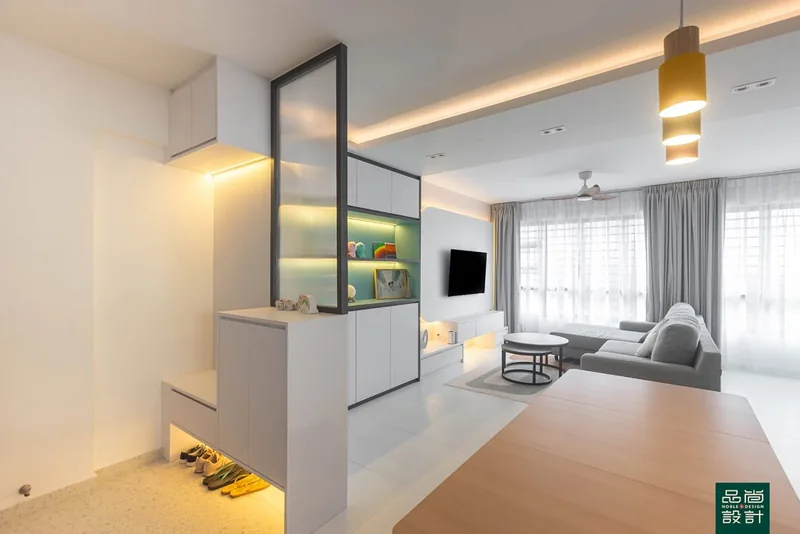
In a Singapore flat the finish rarely fails first, the substrate under it does. Durable choices are mostly wet-area choices: a waterproofing build-up that meets HDB's limits, cabinet carcasses specified for humidity, and hardware specified for corrosion. HDB caps the total thickness of floor finishes and screed at 50mm and requires the waterproofing membrane to be upturned a minimum of 150mm against walls and kerbs. Everything visible can be replaced later; the buried layers cannot.
- Water, not wear, is what ages a Singapore flat
- The wet-area build-up: 50mm total, 150mm upturn, one UPVC detail
- Kitchens are not waterproofed the way bathrooms are
- New BTO flats: the three-year rule reorders the plan
- Carpentry: specify the carcass for humidity, not the door for the photo
- Air-conditioning is the second water source in the flat
- Windows and metal: the parts that corrode are the parts that hold
- The home renovation ideas Singapore flats reward are often the cheaper ones
Singapore's climate does not wear a flat down evenly. Heat cycles tile and substrate at different rates, humidity sits inside carcasses that never fully dry, and wind-driven rain hits the same elevations year after year. The most durable home renovation ideas Singapore flats reward are unglamorous ones: a wet-area build-up that complies with HDB's thickness limits, carpentry specified for moisture rather than for the door finish, and metal hardware specified for corrosion. Anything visible in a photograph can be swapped later; the layers buried under tile cannot, at least not without hacking the room open again.
Water, not wear, is what ages a Singapore flat
HDB is unusually direct about the mechanism behind the most common inter-floor dispute in public housing:
"Ceiling leaks occur when water from the flat above leaks into your unit's ceiling through the concrete floor slab. This usually happens because of wear and tear of the waterproof membrane and screed in the floor slab." — HDB Home Care Guide, Ceiling Leaks
A stain on a downstairs ceiling is almost always a renovation decision made upstairs years earlier, in a bathroom that looked finished. HDB places the repair on both households: flat owners are responsible for the upkeep of their own floor and ceiling slabs, so the upstairs and downstairs neighbours have to arrange the repair work jointly and split the cost. Humidity also drives spalling concrete, which HDB attributes largely to carbonation; HDB's advice is to seal cracks and disused drilled holes and to ventilate humid rooms.
CASE received 787 complaints against renovation contractors in 2025, down 18.2% from 962 in 2024, and renovation remained the second-highest industry for prepayment losses that year.
The wet-area build-up: 50mm total, 150mm upturn, one UPVC detail
HDB's building-works guidelines fix the build-up before any designer touches it:
"Total thickness of floor finishes and screed must not exceed 50mm. Use the pre-packed waterproofing screed and waterproofing membrane in bathroom/ toilets before laying new floor finishes. Membrane should be upturned (minimum 150mm) against the walls and kerbs." — HDB Renovation Guidelines for Building Works
The correct sequence in a toilet is hack to bare slab, hack roughly 25mm deeper around every pipe penetration and fill it with non-shrink grout, then membrane, then screed, then tile — the order HDB sets out in its recommended re-screeding method for ceiling leaks. HDB's method gives the membrane 6 to 12 hours to set before screeding and specifies a new waterproof screed layer at least 20mm thick laid to a gentle gradient for drainage. HDB also requires a UPVC floor trap grating with a long collar at the floor traps; the collar carries waterproofing into the pipe instead of stopping at a raw concrete edge, where slab-level seepage starts.
A homeowner can inspect all of this by asking for photographs at three moments — the bare hacked slab, the membrane with its upturn visible against wall, kerb and pipe, and standing water held on the membrane before screeding. A flood test, plugging the trap and leaving water standing while someone watches the ceiling of the unit below, is the only check that finds a pinhole before it is buried. Fixing a failed membrane afterwards costs plus the loss of the room while the work is redone.
The 50mm cap is a design constraint rather than paperwork: stone slabs on a thick mortar bed and levelling screeds over old tiles both breach it.
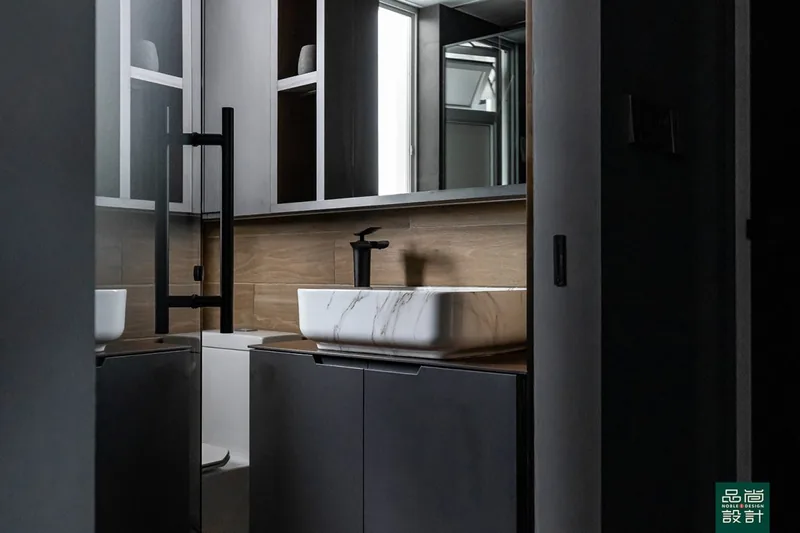
Kitchens are not waterproofed the way bathrooms are
The single most useful sentence HDB publishes for kitchen design is a maintenance instruction:
"Avoid washing your kitchen, and mop the kitchen floor instead, as there is no waterproofing membrane beneath the kitchen floor tiles." — HDB Home Care Guide, Ceiling Leaks
For kitchens and open balconies HDB requires pre-packed waterproofing screed, but the waterproofing membrane with its minimum 150mm upturn is required only around the sanitary stacks, within a radius of 400mm. Kitchen floors in an HDB flat are therefore designed to be damp-mopped, never hosed. Two details follow: the sink cabinet gets a removable base tray rather than a fixed plywood floor, and the plinth under wet-zone carpentry is aluminium or solid surface, not laminated board on tile.
HDB also warns that some flat layouts contain enclosed sanitary ducts in the kitchen fitted with a weephole to alert residents to leaks inside the duct, and states that these "should not be sealed or blocked with kitchen carpentry or other fixtures". Tall pantry and fridge cabinets are the usual offenders; the fix is a removable panel.
New BTO flats: the three-year rule reorders the plan
Owners of newly completed flats must wait three years from completion of the block before removing wall or floor finishes in bathrooms and toilets, and a permit is required before hacking or altering any walls, per the HDB renovation guide on MyNiceHome. HDB allows laying floor finishes over existing finishes with adhesive only, provided there is just one existing layer of finishes including cement screed, the new finish including the adhesive does not exceed 13mm, and the floor trap is not tampered with. A cement mortar kerb of up to 100mm in height and width, which HDB permits in a bathroom without a permit, plus a shower screen and fresh silicone at the wall-to-floor junction, outperforms anything more ambitious in a flat that cannot yet be opened up.
Carpentry: specify the carcass for humidity, not the door for the photo
Cabinet doors are the part everyone chooses and the part least likely to fail. Carcasses in wet zones should be moisture-resistant plywood, with aluminium framing where carpentry meets a service yard or open balcony, because those locations see rain blow-in and standing humidity that no board edge survives. Cut edges are the weak point: thick PVC or ABS edging holds up where thin paper foil peels once water gets behind it. Hinges and runners in bathrooms and yards should be stainless, not nickel-plated steel that blooms rust at the pivot.
Fixing method is regulated, and the rule changes what can be hung on a wall. HDB requires that fasteners and connectors used for gypsum partitions, wall panels and false ceilings fixed to reinforced concrete "must not exceed 6mm in diameter and 40mm in penetration depth". A 40mm anchor is not a structural fixing for a loaded floor-to-ceiling unit, so tall storage should be floor-borne with the wall fixing acting only as restraint.
Air quality inside carpentry is partly regulated too. From 1 January 2026, NEA requires interior paints sold in Singapore to contain no formaldehyde, with in-can content below 0.01% weight by weight. That rule covers paint only and does not reach the adhesives in composite wood, so board emission grade for carcasses and doors has to be written into the contract separately if it matters to the household.
Air-conditioning is the second water source in the flat
Condensate is water the design has to route, and HDB treats it that way: condensation water must be properly discharged into a nearby floor trap in the flat, all air-conditioner pipe joints must be insulated to prevent condensation and dripping, and all piping must be run internally with no hacking of holes or openings through existing reinforced concrete structures within the unit, according to HDB's air-conditioner installation guidelines. Installation must be by a BCA-trained air-conditioning condensing unit installer, an installation report goes to the HDB Branch within 14 days, and the ledge is for the condensing unit alone.
Two build details decide whether an air-conditioning system stays dry. A condensate line needs continuous fall with no sag between fan coil and floor trap, because one low point holds water, grows biofilm and backs up into the ceiling board. The false ceiling hiding that pipe run needs a removable access panel at the fan coil, and HDB requires false ceilings to keep a minimum clearance height of 2.4 metres measured from finished floor level.
Windows and metal: the parts that corrode are the parts that hold
Window works must be carried out by a BCA-approved window contractor listed with HDB, and HDB advises checking windows once every 6 months to confirm there are no loose or worn-out parts. HDB's published window specification doubles as a shopping list for anything metal in a tropical flat: friction stays in stainless steel grade 304 or equivalent, minimum thickness not less than 2.50mm and length not less than half the window leaf width, with a minimum of 4 screws on each side of the friction stay; casement window leaves not exceeding 700mm wide; sliding panels not exceeding 1.20m; and glass louvres of minimum thickness not less than 6mm, wire-glass type, with an aluminium U-channel cleat at every louvre. The same logic governs laundry racks, grilles and gates: grade 304 stainless or powder-coated aluminium, never mild steel under a decorative coat.
The home renovation ideas Singapore flats reward are often the cheaper ones
Overlaying a sound toilet floor is frequently better than hacking it, because hacking resets the waterproofing clock and disturbs a slab that has not leaked. Homogeneous porcelain outperforms marble in a household that cooks with acid and soy. A bulkhead over the aircon pipe run beats a full false ceiling, keeps the 2.4m clearance comfortable, and removes a sealed cavity where warm humid air meets cold pipe.
Contractor choice belongs in the same durability conversation, because the CaseTrust scheme regulates exactly the failure modes that leave a bathroom half-finished: CaseTrust caps the initial deposit at a maximum of 20% of total cost, requires a workmanship warranty of 12 months from completion, and requires a deposit performance bond, per CASE. Under the Housing and Development (Renovation Control) Rules, an HDB flat owner must engage a contractor listed in HDB's Directory of Renovation Contractors, and contravention is an offence carrying a fine not exceeding S$5,000. Noble Interior Design Pte. Ltd. is listed in HDB's Directory of Renovation Contractors (DRC Ref: HB-12-5230A, UEN 201722629H) and is CaseTrust-accredited. HDB is explicit that listing is not an endorsement: HDB does not guarantee a listed contractor's work, and the renovation remains a private contract.
- HDB — Renovation Guidelines for Building Works
- HDB Home Care Guide — Ceiling Leaks
- HDB Home Care Guide — Spalling Concrete
- HDB — Renovation Guidelines for Air Conditioner Installation Works
- HDB Home Care Guide — Windows
- HDB — Renovation Guidelines for Window Works
- MyNiceHome — HDB Renovation Guide
- NEA — No formaldehyde in interior paints from 1 January 2026
- CASE media release, 9 February 2026
- CASE — CaseTrust accreditation for renovation businesses
- Housing and Development (Renovation Control) Rules
- HDB — Looking for Renovation Contractors
Tell us the flat and when you get the keys.
You will get a written quotation with every line spelled out. Take it and compare it with anyone.
Get a quote