Interior design studio, ID firm or design-and-build: the models compared
Design-only studio, ID firm or design-and-build: how the three Singapore renovation models split design risk, build risk, deposits and site coordination.
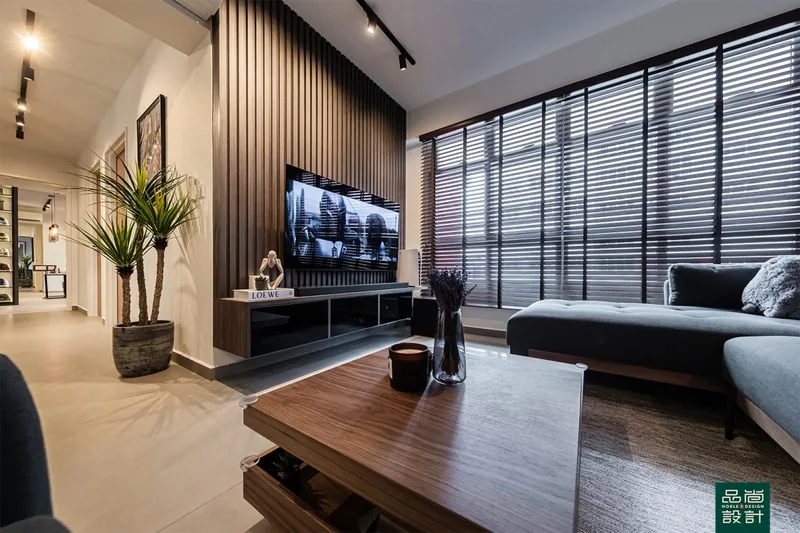
Three delivery models dominate Singapore residential renovation: a design-only studio that sells drawings and hands construction to a separate builder, an ID firm that sells design plus the full renovation package under one contract, and a design-and-build contractor that sells the same single contract but leads with construction capability. The distinction that matters is where the build risk sits, because a single contract removes design-versus-build finger-pointing while a split contract preserves independent specification and pricing. Whichever model is chosen, rule 3(1)(a) of the Housing and Development (Renovation Control) Rules requires the flat owner to engage a renovation contractor registered by HDB and published in its Directory of Renovation Contractors. The right model depends on programme length, project complexity, and how much coordination the household can absorb.
- The three models, sorted by who signs the build contract
- The registration question does not change between models
- Design-only: what it buys, and what it hands back
- Design-and-build: single accountability, one blind spot
- Where the money sits, in every model
- How the models diverge during the messy middle
- Picking a model
The three models, sorted by who signs the build contract
A design-only interior design studio sells drawings, specification and — sometimes — site supervision. The homeowner then signs a separate construction contract with a builder, and the studio's role during construction is to inspect and instruct rather than to deliver. Fees are usually charged for the design phase and, if supervision is included, for the construction phase separately.
An ID firm sells design plus a full renovation package under one contract, with trades employed or subcontracted by the firm. The homeowner receives one quotation, one payment schedule and one entity to hold responsible. Most firms marketed as "interior design" in the local residential market operate this way, whatever the shopfront says.
A design-and-build contractor sells the same single-contract package but leads with construction capability rather than design authorship. The design service exists to make the build sellable, and drawing packages tend to be lighter, faster and closer to standard details. Carpentry-led firms with their own factory frequently sit here.
The three labels are marketing terms and overlap heavily in practice, which is why a search for an interior design studio in Singapore returns firms running all three models under near-identical branding. The reliable way to classify a firm is to ask a single question: after the design is approved, does the firm's own contract cover the physical works, or does a second contract with a second company begin?
The registration question does not change between models
Whatever the model, HDB's rules bind the flat owner, not just the firm. Rule 3(1)(a) of the Housing and Development (Renovation Control) Rules requires an owner intending to renovate to "engage a registered renovation contractor who is registered by the Board, to carry out such renovation works", with a fine not exceeding $5,000 for contravention under rule 3(2).
A design-only arrangement therefore leaves a compliance step with the homeowner that the single-contract models absorb. The studio may specify the works, but the entity actually carrying them out must hold the registration, and the owner is the person the rule addresses. HDB's open dataset on data.gov.sg listed 2,708 registered renovation contractors at its 24 March 2026 update, each row carrying a UEN and a directory reference number, so verification is a lookup rather than an obstacle.
A single-contract firm can hold that registration in its own name rather than relying on a subcontractor's. Noble Interior Design Pte. Ltd. is listed in HDB's Directory of Renovation Contractors (DRC Ref: HB-12-5230A, UEN 201722629H) and is CaseTrust-accredited, which is the pairing worth checking whichever of the three models a firm says it operates.
Listing is also not a quality signal, and HDB states so directly on its Looking for Renovation Contractors page:
"The contractors listed in the DRC are aware of the HDB's requirements when they carry out renovations and to protect the structural integrity of the building. HDB does not endorse nor guarantee the quality of their works. Engaging these contractors is a private contract between you and the contractors, and HDB is not privy to it. The contractors are fully responsible for the contractual obligations towards their client, including the quality of their works."
— Housing & Development Board, Looking for Renovation Contractors
Design-only: what it buys, and what it hands back
Separating design from construction buys independence. A studio with no margin in the build has no financial reason to specify the carpentry its own factory happens to produce, to prefer the tile supplier offering the best rebate, or to under-scope demolition to win the job. For clients who intend to tender the construction to three builders, that independence is the entire point.
Separation also buys a second set of eyes on variations. When a builder claims that a scope item was never in the contract, an independent designer who wrote the specification is a better arbiter than the builder's own project manager.
What separation hands back to the homeowner is coordination risk and a gap in accountability. A defect in a tiled shower may originate in the specification, in the waterproofing application, or in the sequence in which the two were carried out, and two contracted parties will each locate the cause inside the other's scope. Design-only works best where the homeowner has the time, temperament and technical literacy to run that interface, or where the project is large enough to justify paid construction-stage supervision.
Design-and-build: single accountability, one blind spot
Combining the two removes the interface. One contract covers drawings and delivery, one project manager sequences the trades, and a defect has one owner regardless of whether its cause was drawn or built. For a typical HDB or condominium renovation compressed into a few months, that is worth a great deal.
The blind spot is that the designer marks their own homework. A firm that both specifies and builds has an incentive to specify what it is efficient at building, and to classify its own errors as client-requested variations. The mitigations are contractual rather than moral: a written specification detailed enough to be tested against, a variation procedure requiring written agreement before work proceeds, and a payment schedule tied to verifiable milestones rather than to elapsed weeks.
An interior design studio operating on this model should be able to produce those documents before deposit, not after. A quotation that lists "renovation works — lump sum" against a five-figure number is not a specification and cannot be enforced as one.
Where the money sits, in every model
The CaseTrust accreditation criteria for renovation businesses published by the Consumers Association of Singapore set out the contractual baseline accredited firms commit to:
"Accredited businesses must adopt the CaseTrust Standard Renovation Contract, which outlines each party's obligations and specifies work and payment schedules. These include progressive payments, service warranty and transparent pricing."
— CaseTrust Accreditation for Renovation Businesses, Consumers Association of Singapore
Three specific terms in that framework are worth transplanting into any renovation contract, accredited or not. CaseTrust caps initial deposits at maximum 20% of the total cost and requires accredited renovation businesses to purchase a deposit performance bond safeguarding deposit payments against closure, winding up and liquidation, among others; it requires a workmanship warranty for a period of 12 months from the completion date of the works; and it requires variations to be agreed in writing between the business and the consumer before any works.
Accreditation remains uncommon enough that its absence is not disqualifying, but its presence is informative. The CASE media release of February 2026 reports that 268 renovation businesses had been accredited under CaseTrust as of January 2026, against a stated target of accrediting 500 businesses by 2027 — set against the 2,708 companies in HDB's open directory dataset, roughly one accredited firm for every ten listed. The CASE media release of February 2025 reports that of the 962 complaints received against renovation contractors in 2024, approximately 97 per cent were against non-CaseTrust accredited contractors.
How the models diverge during the messy middle
Renovation sequence is unforgiving, and the models differ mainly in who holds the sequence. Hacking and demolition come first, then wet works and waterproofing, then screeding, then electrical and plumbing first fix, then tiling, then carpentry templating on finished surfaces, then installation, with painting near the end so that finished walls are not damaged by later trades.
Each handover in that chain is a place where a model shows its shape. Under a single contract, a tiler who arrives before the plumber has set floor trap levels is the firm's scheduling problem. Under split contracts, the same clash becomes a claim, and the homeowner mediates it while living somewhere else and paying rent.
Regulatory changes land on that same chain. From 1 January 2026, NEA requires paint manufacturers and importers to submit test reports substantiating that the measured total in-can formaldehyde content in each interior paint product sold in Singapore is below 0.01 per cent weight by weight, with industrial and outdoor paints excluded but required to be labelled. The rule reaches paint specifically, and the party writing the finishes schedule should be able to confirm compliance product by product rather than by reassurance.
Picking a model
Choose design-only when independence is worth more than convenience: multiple builders to tender, an unusual property, a long programme, or a client who wants specification authority retained outside the build contract.
Choose a single-contract model when the schedule is short, the trades are many, and no one in the household has the bandwidth to arbitrate between two companies. Most HDB and condominium renovations fall here, which is why most firms sell it.
Choose on documents rather than on renderings in either case. The firms worth shortlisting are the ones whose registered entity appears in HDB's directory, whose deposit sits at or below the CaseTrust ceiling, whose specification names products and quantities, and whose variation clause requires a signature before a trade starts work.
- Housing and Development (Renovation Control) Rules (Cap. 129, R 15), Singapore Statutes Online
- HDB, Looking for Renovation Contractors
- HDB, Renovation Contractors who can carry out Renovation works by Company Name (open dataset)
- CaseTrust Accreditation for Renovation Businesses, Consumers Association of Singapore
- CASE media release, February 2026 (2025 complaint and prepayment statistics; CaseTrust accreditation count)
- CASE media release, February 2025 (2024 complaint and prepayment statistics)
- NEA, No formaldehyde in interior paints from 1 January 2026
Tell us the flat and when you get the keys.
You will get a written quotation with every line spelled out. Take it and compare it with anyone.
Get a quote