Kitchen cabinets in Singapore: carcass, front and hardware explained
What an HDB kitchen cabinet is made of, part by part: carcass boards, door finishes, hinges and runners, the HDB rules that apply, and how to inspect the finished run.

A kitchen cabinet is three purchases sold as one line item: the carcass (the box), the front (door or drawer face) and the hardware (hinges, runners, lift-up fittings). In a Singapore kitchen the carcass decides how the run survives humidity and a leaking sink trap, the front decides how it looks and ages, and the hardware decides how it feels and what fails first. A price quoted per foot run that does not name all three cannot be compared with another quotation.
- The three parts of an HDB kitchen cabinet, and why one price hides them
- Carcass: the box does the waterproofing work
- Fronts: what you touch, and what shows the ageing
- Hardware: the part that fails first
- What HDB actually regulates inside a kitchen
- Formaldehyde: what the 2026 paint rule does and does not cover
- How to inspect a finished run before the final payment
- What moves the price, and where the cheaper option is correct
Three separate products get bundled into one line on a quotation: an HDB kitchen cabinet is a carcass (the box), a front (the door or drawer face) and hardware (the hinges, runners and lift-up mechanisms). Each comes from a different supplier, each fails differently, and any of the three can be substituted for something cheaper without the drawing changing. Reading a carpentry quotation in Singapore means pulling the three apart.
The three parts of an HDB kitchen cabinet, and why one price hides them
Carpentry in Singapore is sold by the foot run: one price per linear foot, quoted separately for bottom cabinets, top cabinets and tall units. A foot-run price describes length, not content. Two workshops can quote the same drawing at very different numbers and both be honest, because one is building a moisture-resistant plywood box with branded undermount runners while the other is building a melamine-faced chipboard box with side-mounted rollers.
A comparable quotation names four things for every run: the carcass board and its thickness, the front material and finish, the edge banding material and thickness, and the hardware brand and series. Anything left unnamed is a variable the workshop is free to change after the deposit is paid. Ask for hardware model numbers in writing, because a series name can be checked against the manufacturer's own catalogue while the phrase "soft-close hinges" cannot.
Carcass: the box does the waterproofing work
The carcass is the structural box — two side panels, a base, a back and any fixed shelves, typically 15mm to 18mm board. Moisture-resistant plywood bonded with a phenolic (WBP) glue line is the usual choice for wet zones because the glue line, not the timber, is what survives repeated wetting. Blockboard is lighter and cheaper but holds screws poorly near a cut edge, exactly where a hinge plate or runner is fixed.
Moisture-resistant MDF is flat and stable, which makes it a good substrate for a sprayed finish, and it swells irreversibly if an unsealed cut edge gets wet. Aluminium carcasses shrug off water and are worth the premium under the sink, at the cost of a hollow sound and visible dents. The most useful upgrade in a Singapore kitchen is rarely the whole run: it is the sink cabinet, where a weeping trap will sit against the base panel for weeks before anyone notices.
Edge banding decides how long a carcass lasts. Every cut edge should be banded, including the ones nobody sees inside the sink cabinet, because an unbanded edge is raw board with the core exposed to steam. Ask whether the banding is PVC or ABS, what thickness it is (0.4mm banding chips off a drawer front that 2mm banding survives), and whether it is bonded with hot-melt or PUR adhesive.
Fronts: what you touch, and what shows the ageing
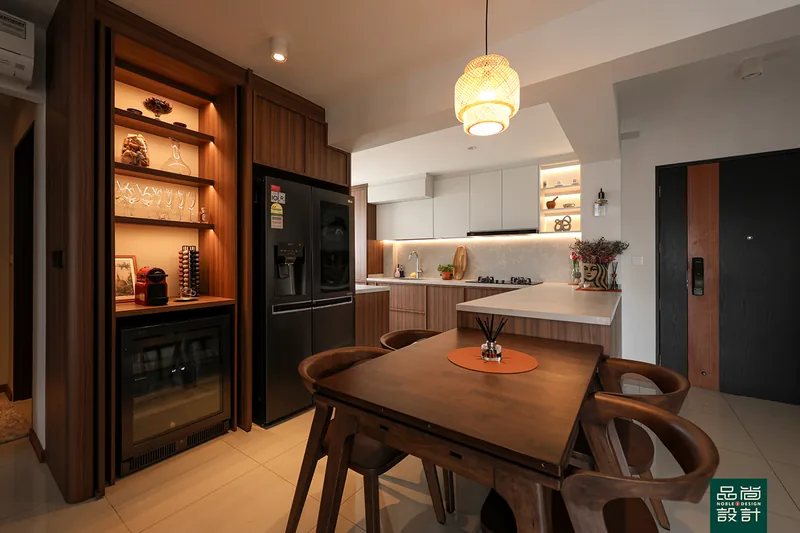
High-pressure laminate over a moisture-resistant substrate is the workhorse front — hard, replaceable, and honest about the seam at its edge. Acrylic gives the deepest gloss and shows every fingerprint and swirl mark, so the protective film should stay on until handover and be peeled in front of you, which is when scratches underneath get found rather than argued about. PET and matte laminates trade that depth for far less glare, worth considering under a west-facing window.
Sprayed finishes, usually quoted as 2K or lacquer, are the only way to carry one seamless colour across a door with a profiled edge, and they chip at corners where laminate would not. A sprayed door can be resprayed; a chipped laminate door has to be replaced. Veneer moves with humidity and needs its back face sealed, or it cups within a year.
Colour batches drift, so a replacement door ordered a year later will not match the original under daylight. Ask for one offcut of each front finish to be left in the flat at handover; storing it turns a future repair into a same-day job.
Hardware: the part that fails first
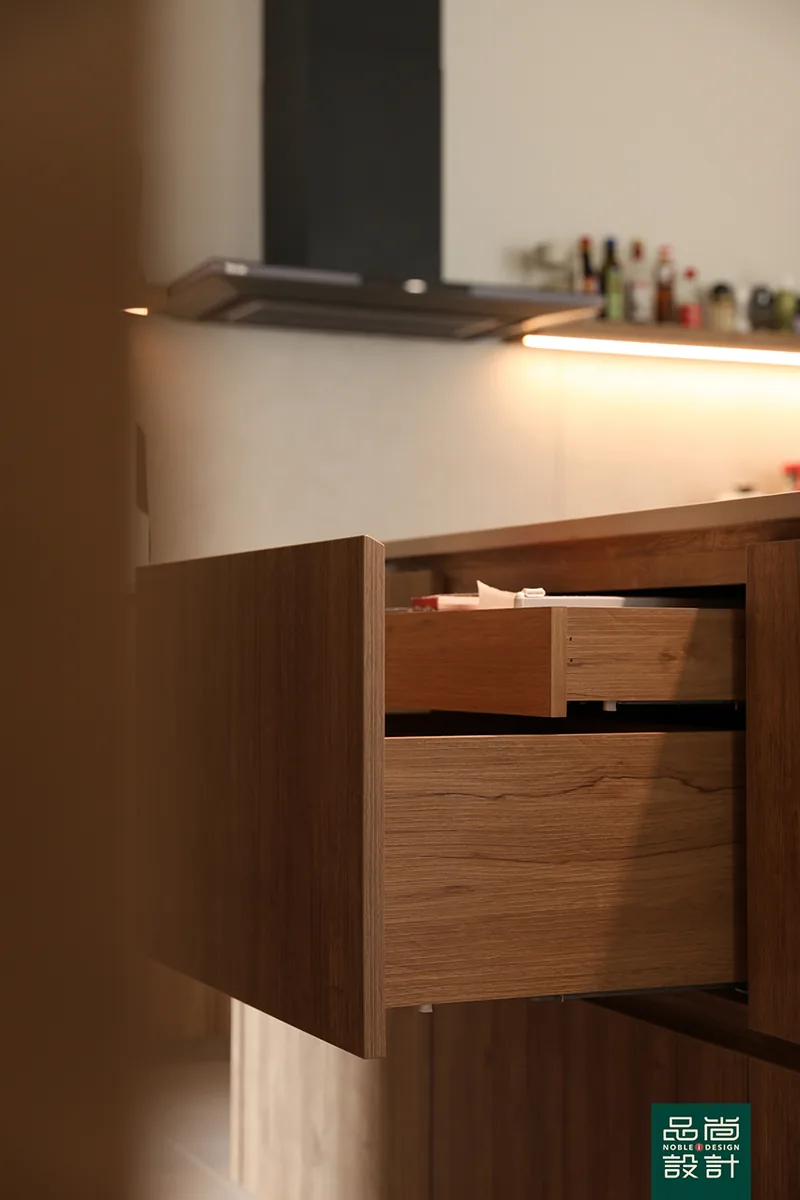
Hinges, runners and lift-up fittings are the moving parts, and moving parts generate the complaint two years later. A standard concealed hinge sits in a 35mm cup bored into the door and adjusts in three axes — side, depth and height — which is how a dropped door gets corrected without dismantling anything. Soft-close is either integrated into the hinge or clipped on as a separate damper; integrated is quieter and cannot go missing.
Drawer runners come in three tiers: side-mounted rollers (partial extension, visible, cheapest), ball-bearing side runners (full extension, load-rated, still visible), and undermount runners (full extension, hidden, soft-close built in, and unforgiving of a drawer box that is a millimetre out of square). Load ratings are published per series in kilograms, and a cutlery drawer and a pots drawer are not the same duty — the pots drawer is the one that sags.
Lift-up and flap fittings are sized by door weight and door height, not by eye. A strut with the wrong power either fights you on the way down or drifts open, and the remedy is a different strut, not an adjustment.
What HDB actually regulates inside a kitchen
Constructing a kitchen counter top in an HDB flat needs no permit, but HDB's renovation guidelines for building works attach conditions: construction of a concrete shelf is not allowed, only one layer of 63mm hollow block may be erected to support the top, and the total thickness of cement mortar base and tile finishes is not allowed to exceed 50mm. Hacking or altering a wall is a different matter — including the half-wall between kitchen and living room — because the HDB renovation guide states that "Before you plan to hack down or alter any walls in your flat, you need to obtain a permit from HDB."
One rule catches carpenters and homeowners repeatedly. Many flats have an enclosed sanitary duct in the kitchen fitted with a weephole, and HDB is explicit about what carpentry may not do to it:
"These weepholes should not be sealed or blocked with kitchen carpentry or other fixtures, so as not to cause damage to your renovations in case of leaks." — HDB, Renovation Guidelines for Building Works
HDB's renovation guidelines for building works also put the duty of access on the owner, listing among the conditions for a kitchen counter top that "Flat owners are responsible for the removal and reinstatement of the fixtures for inspection and maintenance." A tall unit or a bank of drawers built hard against a duct means that on the day the duct leaks, the carpentry comes off at the owner's expense. A removable panel, screwed rather than glued and sealed, costs almost nothing at build time.
Renovation hours constrain the sequence of a kitchen fit-out. HDB allows general renovation works from 9am to 6pm Monday to Saturday with none on Sundays and public holidays, while noisy works such as demolishing walls and removing wall or floor finishes are confined to 9am to 5pm Monday to Friday, per the HDB renovation guide. Under the Housing and Development (Renovation Control) Rules a flat owner must engage a contractor listed in HDB's Directory of Renovation Contractors, and contravening that is an offence carrying a fine of up to S$5,000. HDB runs a demerit point system for those listed contractors, under which a contractor accumulating at least 24 demerit points within 24 months is delisted from the Directory.
Formaldehyde: what the 2026 paint rule does and does not cover
From 1 January 2026 the National Environment Agency requires interior paints sold in Singapore to contain no formaldehyde, with measured in-can content below 0.01% weight by weight (NEA). The NEA requirement covers paint. Adhesives in composite wood — the glue holding together the chipboard, MDF and plywood a kitchen is actually built from — sit outside it.
Anyone specifically concerned about indoor air quality should ask the carpenter for the board's own emission-class documentation rather than assume the paint rule covers the boxes. A supplier who produces the board specification sheet is telling you something checkable; one who answers "all our board is eco-friendly" is not.
How to inspect a finished run before the final payment
- Reveals: the gap around every door and drawer front should be even top to bottom and consistent between neighbours. Uneven gaps are a hinge adjustment, not a defect to live with.
- Edge banding present on every cut edge, including inside the sink cabinet and around service cut-outs.
- Sink and tap cut-outs sealed on the raw edge of the countertop substrate and the carcass below.
- Carcasses levelled and fixed back to a batten or the structure, not held straight by the countertop.
- Every drawer pulled to full extension one at a time: no drop at the end of travel, no rubbing.
- Silicone at the countertop-to-backsplash junction continuous and tooled, not a smeared bead.
- Appliance clearances checked against the appliance manual rather than the drawing.
- Weephole and duct access left clear and openable without cutting anything.
Walk the inspection list with the carpenter present before releasing the final payment. CaseTrust-accredited renovation businesses must provide a workmanship warranty of 12 months from the completion date of the works (CASE), so the recorded completion date matters as much as the defects list.
What moves the price, and where the cheaper option is correct
A melamine-faced chipboard carcass with good hinges and runners will feel better in daily use than moisture-resistant plywood fitted with the cheapest hardware, because hardware is the part that moves. The place not to economise is the sink cabinet and the carcasses either side of it, where every water problem in a Singapore kitchen begins. Noble Interior Design Pte. Ltd. is listed in HDB's Directory of Renovation Contractors (DRC Ref: HB-12-5230A, UEN 201722629H) and is CaseTrust-accredited.
- HDB — Renovation Guidelines for Building Works
- HDB Renovation Guide (MyNiceHome)
- Housing and Development (Renovation Control) Rules — Singapore Statutes Online
- NEA — No formaldehyde in interior paints from 1 January 2026
- HDB — Directory of Renovation Contractors
- CASE — CaseTrust accreditation for renovation businesses
Tell us the flat and when you get the keys.
You will get a written quotation with every line spelled out. Take it and compare it with anyone.
Get a quote