Flooring Singapore flats: tile, vinyl or laminate
Which floor finishes HDB regulates, how tile, vinyl, laminate and engineered timber behave in Singapore humidity and wet areas, and how to compare three quotes that are not quoting the same job.
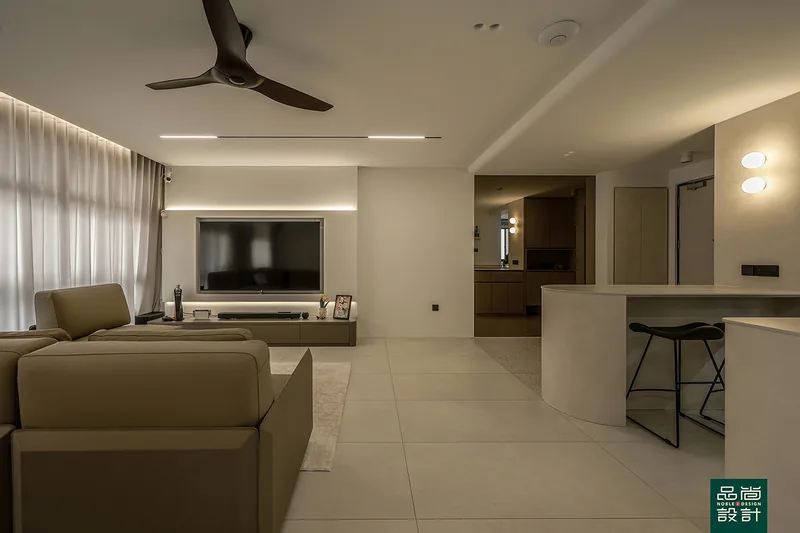
Tile, vinyl and laminate are not competing on looks; they are competing on what they ask of the slab and the wet areas. HDB requires a permit to replace tile, terrazzo, marble or timber finishes but none to lay vinyl, carpet or linoleum. Laminate is grouped with timber and allowed over existing finishes only without cement screed, hacking or a raised platform. Wet areas settle the argument on their own: tile is the only one of the four that is indifferent to standing water.
- Permits: which finishes HDB regulates, and which it ignores
- What flooring Singapore flats can take: the four real options
- Tile: the 50mm ceiling, the waterproofing and the mess
- Vinyl and laminate in a humid climate
- Wet areas and thresholds decide the choice for you
- Comparing quotes without comparing different jobs
Flooring Singapore homeowners end up with is usually chosen in a showroom, under lighting designed to flatter it, from a sample the size of a place mat. The decision that matters is made somewhere else: on the slab, in the wet areas, and in the paperwork. Tile, vinyl and laminate each ask something different of the floor beneath them, and each fails in a different way when it does not get it.
Permits: which finishes HDB regulates, and which it ignores
HDB draws a sharp line between finishes bonded into the building fabric and finishes that merely sit on it. Replacing ceramic, homogeneous, terrazzo, marble, parquet/timber or other tiles requires a renovation permit; laying vinyl finishes, carpet or linoleum requires none, according to HDB's Renovation Guidelines for Building Works.
Laminate sits in an unexpected place in that table. HDB groups laminate with timber — "Laying/ replacement of parquet/ timber flooring (also known as laminated or bamboo flooring)" — and attaches conditions rather than a permit:
"For flats with existing floor finishes: The laying of flooring over existing finishes should not involve the following: Raising the floor as a platform; Usage of cement screed; Hacking/ removal of existing floor finishes." — HDB, Renovation Guidelines for Building Works
Permit or no permit, the contractor must be listed. The Housing and Development (Renovation Control) Rules require a flat owner to engage a contractor in HDB's Directory of Renovation Contractors, with a fine of up to S$5,000 for engaging one that is not listed, and HDB's own guidance is explicit that listing is neither an endorsement nor a guarantee of a contractor's work — the renovation contract is a private one between the homeowner and the contractor.
What flooring Singapore flats can take: the four real options
Homogeneous and porcelain tile is a dense, through-bodied ceramic laid in adhesive or mortar over screed. Tile is the only common finish that is genuinely indifferent to standing water, and the only one that survives a fridge being dragged across it. Tile is also cold, loud, unforgiving to dropped glassware, and the most disruptive of the four to install.
Vinyl plank — SPC, WPC or glue-down LVT — is a printed film over a plastic core. Vinyl goes down over a sound existing floor in days, needs no HDB permit, and is quiet to install because nothing is demolished. Its weakness is the substrate: every hollow, hump and grout line under a vinyl plank eventually shows.
Laminate is a decorative paper over a high-density fibreboard core. The surface is genuinely hard-wearing and the pattern registration is the most convincing of the wood imitations, but the core is compressed wood fibre, and wood fibre swells irreversibly when it gets wet. A laminate board that has taken water at the joint stays swollen after it dries.
Engineered timber is a real hardwood veneer on a plywood base. Engineered timber looks and feels like wood because the top layer is wood, it can sometimes be sanded once, and it is the most sensitive of the four to humidity swings and to point loads from furniture.
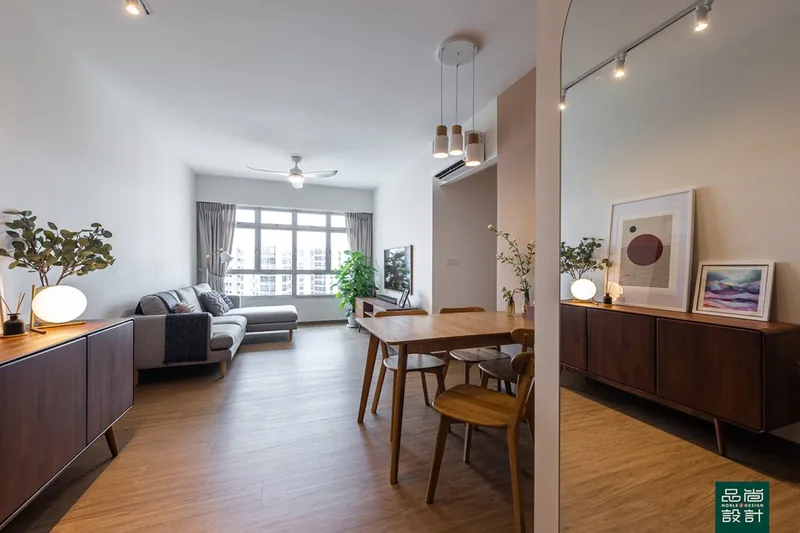
Tile: the 50mm ceiling, the waterproofing and the mess
Thickness is a regulated quantity in tiling work, not a design preference. HDB's building works guidelines state that where floor finishes are replaced, the "total thickness of floor finishes and screed must not exceed 50mm" — which is why a tiler who wants a thick screed bed to correct an uneven slab may run out of allowance before the floor is level.
Wet areas carry their own prescribed build-up. HDB's building works guidelines require pre-packed waterproofing screed and a waterproofing membrane in bathrooms and toilets before new floor finishes are laid, with the membrane "upturned (minimum 150mm) against the walls and kerbs", and UPVC floor trap gratings with long collars at the floor traps. A homeowner can verify the upturn with a photograph taken before the screed goes on, and should ask for one.
Demolition is where a tiling job becomes a neighbour problem. Removing existing floor finishes is classified by HDB as noisy work, permitted only Monday to Friday, 9am to 5pm, and not on weekends, public holidays or the eve of major public holidays, per the HDB renovation guide — a narrower window than the general 9am to 6pm Monday to Saturday allowance in the same guide. Hacking an entire flat's floor also produces debris measured in lorry loads, and disposal is a line item worth seeing in writing.
Workmanship in tiling is inspectable by anyone. Tap every tile with a knuckle or a coin: a dull, drummy note means the adhesive did not make full contact and the tile will crack under load. Run a straightedge across the joints to find lippage between adjacent tiles. Check that grout joints line through at doorways and that cut tiles are pushed to the least visible edge, not to the doorway a visitor walks through.
Vinyl and laminate in a humid climate
Dimensional movement is the enemy shared by vinyl and laminate. Both are floating assemblies in most installations, both expand and contract as one sheet, and both need the manufacturer's perimeter expansion gap left open behind the skirting rather than sealed with silicone. A kitchen carpentry run or a full-height wardrobe installed on top of a floating floor pins it, and a pinned floor peaks in the middle.
Water behaves differently under vinyl than under laminate. A vinyl plank is unaffected by water itself, but water that reaches the underside releases the adhesive and travels sideways under the whole floating run. A laminate board absorbs water at the cut edge and swells, and the swelling does not reverse — which rules laminate out of kitchens, service yards and anywhere near a bathroom threshold.
Wear ratings are the specification to ask for by name. Laminate carries an abrasion class, vinyl carries a wear-layer thickness in millimetres, and both appear on the manufacturer's technical data sheet rather than the brochure. A household with a dog, a toddler and a wheeled office chair is not the household these products are rated against by default.
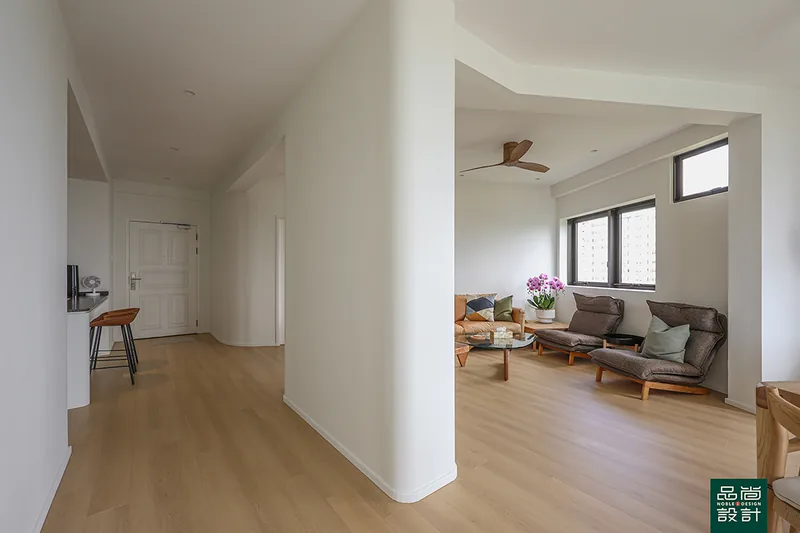
Wet areas and thresholds decide the choice for you
Bathrooms are settled by regulation before taste enters. New flats carry a restriction period, stated plainly in HDB's renovation guide:
"If you have a newly built BTO flat, you will have to wait 3 years before removing any wall or floor finishes in the toilets. This is to prevent damage to the waterproofing in these wet areas. Instead of hacking away the original tiles, you can overlay them with tiles of your choice." — HDB, Renovation Guide on MyNiceHome
Thresholds are where two finishes of different thickness meet, and they are the detail most often left to the installer to improvise. A tiled bathroom floor sitting higher than a vinyl bedroom floor needs a kerb and a transition profile that still lets the door swing; a bathroom floor that ends up higher than its own kerb sends water out into the bedroom. Falls to the floor trap have to be preserved through any change of finish, which is a strong argument against building a bathroom floor up.
Kitchens and service yards sit between a bedroom and a bathroom in how much water they see. Tile remains the defensible choice at the sink, the washing machine and the yard door, and a change of material at the kitchen doorway is a cleaner detail than one continuous vinyl run that ends at a washing machine hose.
Comparing quotes without comparing different jobs
Three quotations for the same flat routinely differ by more than the material, because one includes hacking, disposal, screeding and waterproofing while another assumes the existing floor stays. Ask for these separated:
Accreditation is a variable that is cheap to check. CASE recorded 787 renovation complaints in 2025, down 18.2% from 962 in 2024, and reported that around 97% of the 962 complaints in 2024 were against contractors that were not CaseTrust-accredited, as set out in CASE's 2026 and 2025 media releases. Under the CaseTrust scheme for renovation businesses, the initial deposit is capped at 20% of the total contract value, a deposit performance bond is required, and a 12-month workmanship warranty runs from completion. Noble Interior Design Pte. Ltd. is listed in HDB's Directory of Renovation Contractors (DRC Ref: HB-12-5230A, UEN 201722629H) and is CaseTrust-accredited.
The honest answer for many flats is the less invasive one. Where the existing tiles are sound and single-layer, vinyl over a properly levelled floor delivers most of the visual change without the demolition, and what is not spent on hacking the bedrooms is better spent on the bathrooms, where the finish is doing real work.
- HDB — Renovation Guidelines for Building Works (floor finishes permit table, laminate/timber conditions, 50mm and 150mm rules)
- HDB / MyNiceHome — HDB Renovation Guide (BTO 3-year toilet restriction, renovation hours)
- Housing and Development (Renovation Control) Rules — Singapore Statutes Online
- HDB — Looking for renovation contractors (HDB does not endorse listed contractors)
- CASE — February 2026 media release on 2025 complaint statistics
- CASE — 2025 media release on 2024 prepayment losses and renovation complaints
- CaseTrust — accreditation for renovation businesses
Tell us the flat and when you get the keys.
You will get a written quotation with every line spelled out. Take it and compare it with anyone.
Get a quote